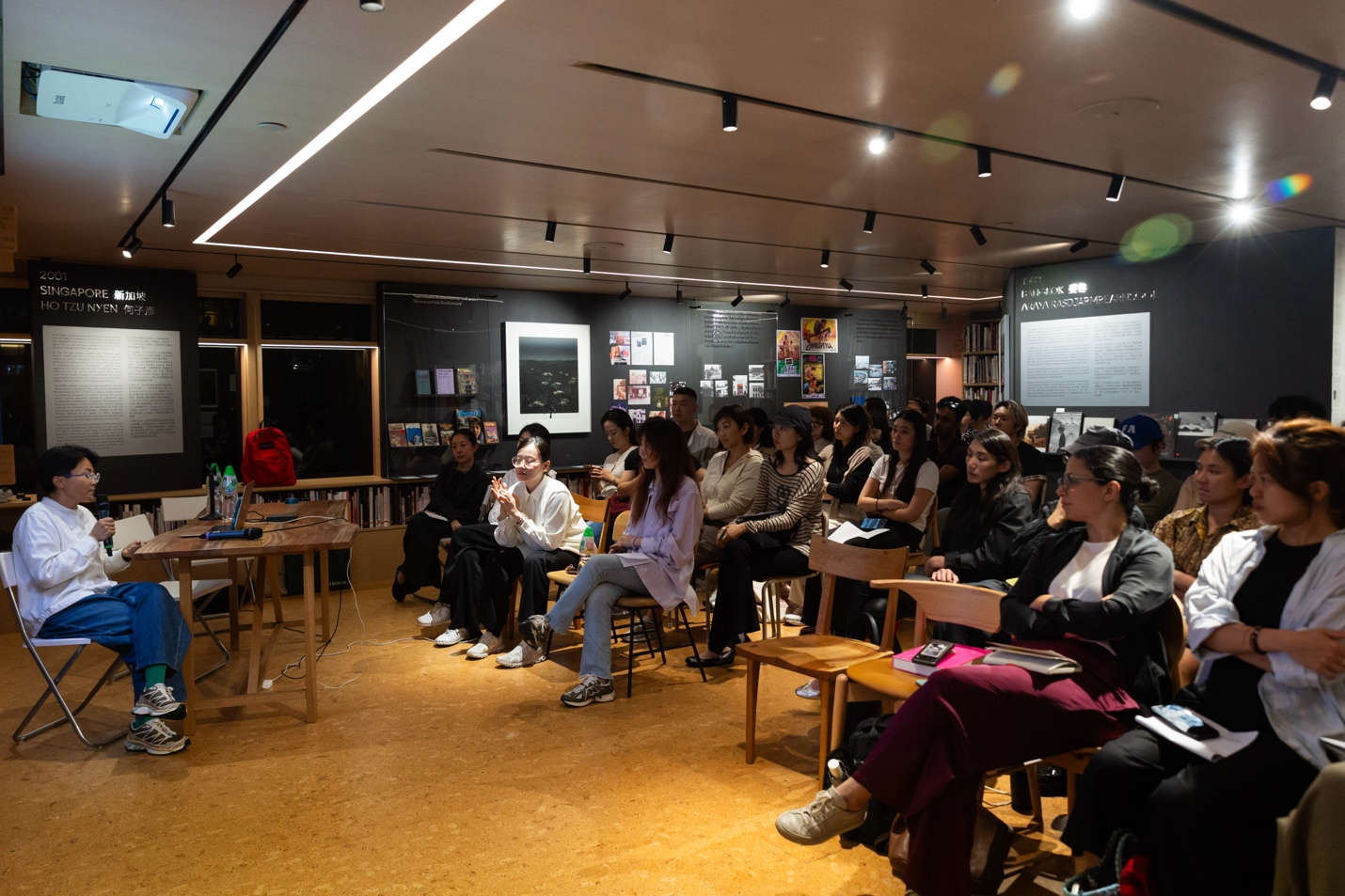
“Bloody Worm: Nomadic Bodies, Conscious Experience, and Embodiment Practice” Launch Event, March 31, 2026, Asia Art Archive (AAA) Library. Image courtesy of Zoie Yung.
On March 31, 2026, Bloody Worm: Nomadic Bodies, Conscious Experience, and Embodiment Practice—a year-long curatorial project initiated by independent curator Yifei Tang and supported by the Octone Foundation—launched with a public event at the Asia Art Archive (AAA) Library.
The evening opened with Tang outlining the project's conceptual framework, methodology, and year-long structure, followed by presentations from participating artists Bo Choy, Cici Wu, and Chan Ting. Each artist shared their practice, their ongoing research, and their plans for the coming year, in what marked the project's first public appearance.
Following is a summary of the evening's talks, revised from the event's video documentation.
Yifei Tang: How the Bloody Worm Project Will Grow
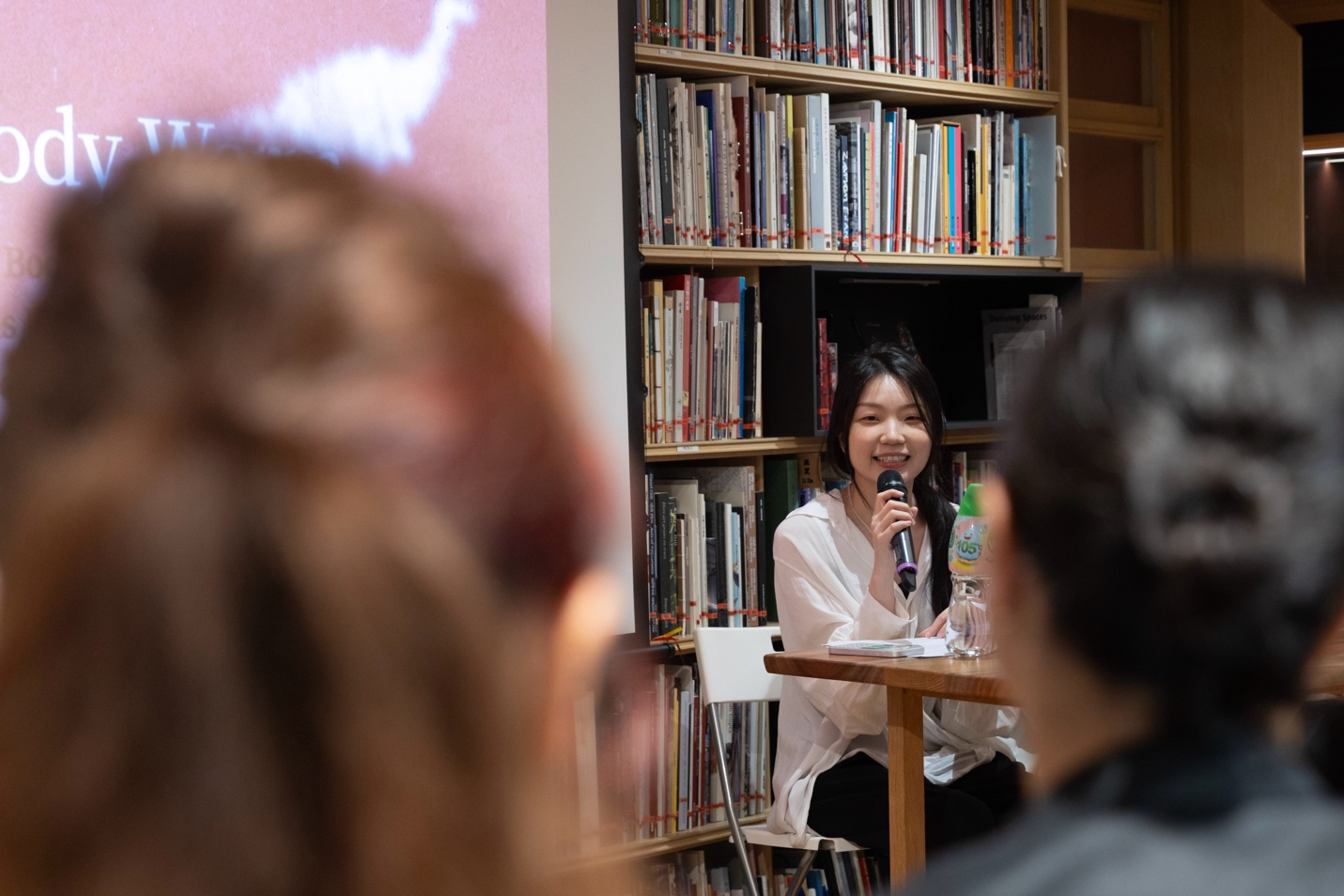
“Bloody Worm: Nomadic Bodies, Conscious Experience, and Embodiment Practice” Launch Event, March 31, 2026, Asia Art Archive (AAA) Library. Image courtesy of Zoie Yung.
Bloody Worm does not begin from the logic of the conventional commission, nor from a demand for outcome-led production. It is conceived instead as a long-term curatorial framework built around research, conversation, and support. Over the course of a year, the project will take shape through collaborative research, production assistance, and fieldwork, with archiving and documentation. Through regular internal meetings and artist-led activities, it seeks to follow, slowly and attentively, the development of individual practices as well as the relations that weave within. The project will unfold through seasonal gatherings centered on the artists' research, fieldwork, and production, alongside a series of public programs staged between September and November, including performances, tea gatherings, walks, and community-based events across London, Japan, and Shanghai. In March of the following year, Bloody Worm will culminate in a presentation that brings together the collective processes and materials generated throughout the year.
The title of the project is drawn from a metaphor in a shamanic healing narrative. The French anthropologist Claude Lévi-Strauss revisited the case in "The Sorcerer and His Magic," a chapter of Structural Anthropology; the original account can be traced to Franz Boas's The Religion of the Kwakiutl Indians, which records the Indigenous testimony of Quesalid. Through a concealed technique, the healer transforms an invisible, subjective affliction into an external form that is visible, tangible, and credible.【1】During the launch, Tang explained that this metaphor refers to re-examining the internal mechanics of artistic practice. It highlights how artists, while navigating chaotic and deeply personal perceptual experiences, simultaneously carry historical and cultural genes, creating discourse that traverses multiple contexts. In this sense, Bloody Worm does not advocate mysticism, but rather an open methodological reference point, involving translation, re-composition, and re-narration of personal memory, life trajectories, and particular cultural-historical conditions. The artist, in this formulation, comes to perform the dual roles of the shaman and the patient.
Within the project context, "nomadic bodies" is not confined to geographical displacement and migration. It names a more complex movement across the contextual layers that artists inhabit: the shifting positions they take between narrative subjects, cultural identities, and historical conditions. “Body,” here, extends beyond the physical body to include fictional bodies, social bodies, and forms of embodied experience produced through relation, memory, and narration. “Conscious experience and embodied practice,” meanwhile, it involves acts of selection, positioning, and narrative agency through which personal emotion and memory may become politically legible. Such a process may also open a path through which kinship, psychological distance, and collective emotional connection can be reconsidered.
As Tang noted, "in selecting the artists, our considerations extended beyond the artworks themselves to the broader scope." Bo Choy has been involved in editing work related to art history and exhibition history, while both Cici Wu and Chan Ting have founded independent nonprofit spaces. Such commitments point to a working ethic closely bound to lived realities and to the infrastructures that make artistic practice possible. Therefore, Bloody Worm is conceived not as a project obliged to produce rapid conclusions but rather is understood as a process of re-establishing support networks, finding empathy mechanisms, and reaffirming relationships in an uncertain world. Tang further described the project as a shared process of learning and exploration involving all participants, including the foundation itself. Rather than asking artists to deliver finished works within a fixed timeframe, the project approaches something closer to a “process-driven, multiply supported ‘spiritual residency’.” The process and its accompanying materials are themselves understood as possessing an afterlife of their own, capable of becoming prompts for long-term reflection well beyond the project's framed duration. This expectation that is not oriented towards a single predetermined outcome maybe what most clearly distinguishes Bloody Worm from a conventional commissioning model.
Bo Choy: Writing Images
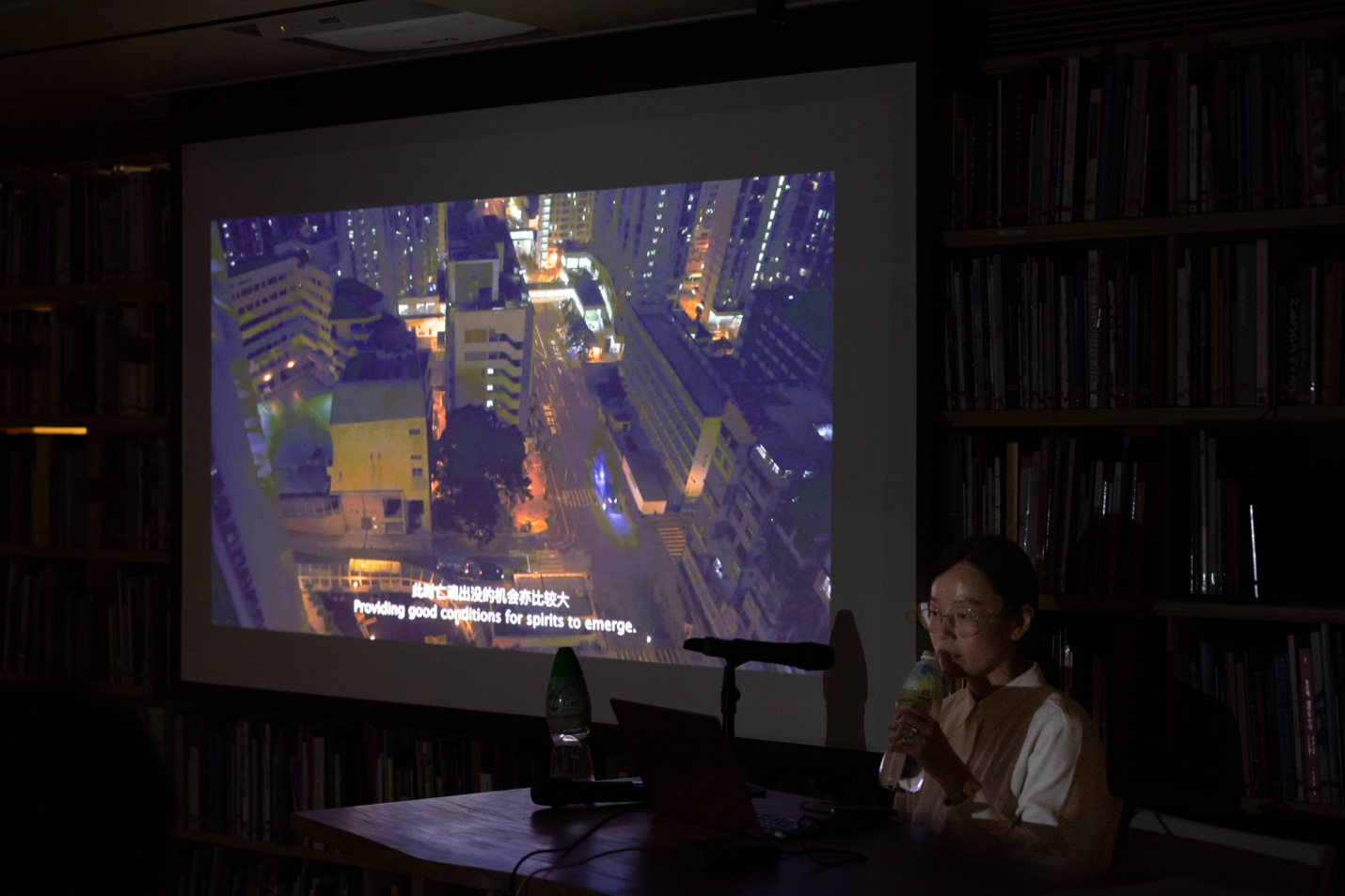
“Bloody Worm: Nomadic Bodies, Conscious Experience, and Embodiment Practice” Launch Event, March 31, 2026, Asia Art Archive (AAA) Library. Image courtesy of Zoie Yung.
Bo Choy opened by revisiting two earlier works and outlining how writing, sound, and costumes function as integral parts of her creative process, and how her image-making has long circled around Hong Kong, the body, land, and historical perception. She first introduced War of Perception (2020), a work centered on “a spirit medium wandering the streets of Hong Kong,” [2] in which image, words, sound, and editing “all converge to evoke a specific mood and emotion.” Choy noted that the work coincided with “a significant historical moment in Hong Kong,” giving it a particular formal and emotional charge.
She then turned to her 2022 poem These Yearnings of the Exiled Souls, to which Time shall We Send Them? and the related moving-image work Yearning of the Exiled Souls. 【3】 Commissioned and developed within Dissolving Earths / Undead Matter, a research framework initiated by curator Sophie J. Williamson, the work emerged from interdisciplinary exchanges among artists, writers, ecologists, geographers, anthropologists, and shamans, against the rapidly shifting social and ecological conditions of Siberian permafrost.【4】 Within this project, Choy entered into dialogue with a shaman living in southeastern Siberia, near Lake Baikal. Beginning from the nomadic custom of burying the afterbirth at one's birthplace, she reflected on how "home" might carry “a double meaning”: wherever one is in the moment, and also where the afterbirth was buried. Through this, she reconsidered the complex connection between the body and the land, and between the individual and their ancestors.
From these recent works she moved to her methodology, identifying "writing" as an important element in the making of moving images and framing the question of "how to write images" as the crux of her practice. She cited Chris Marker's Sans Soleil 【5】 as a profound influence on her filmmaking, particularly in the way sound, text, and image together construct an immersive stream of consciousness. She also reflected on childhood experiences that sharpened her sensitivity to history and politics: visiting a memorial exhibition devoted to political leaders, which later inspired the mascot-like costumes that recur in her films. War of Perception, she added, originated in an intensely specific visual memory, “a priest-like atop a tower, swaying a sword.” This movement, from a single image toward a complete narrative, forms a key aspect of her working method.
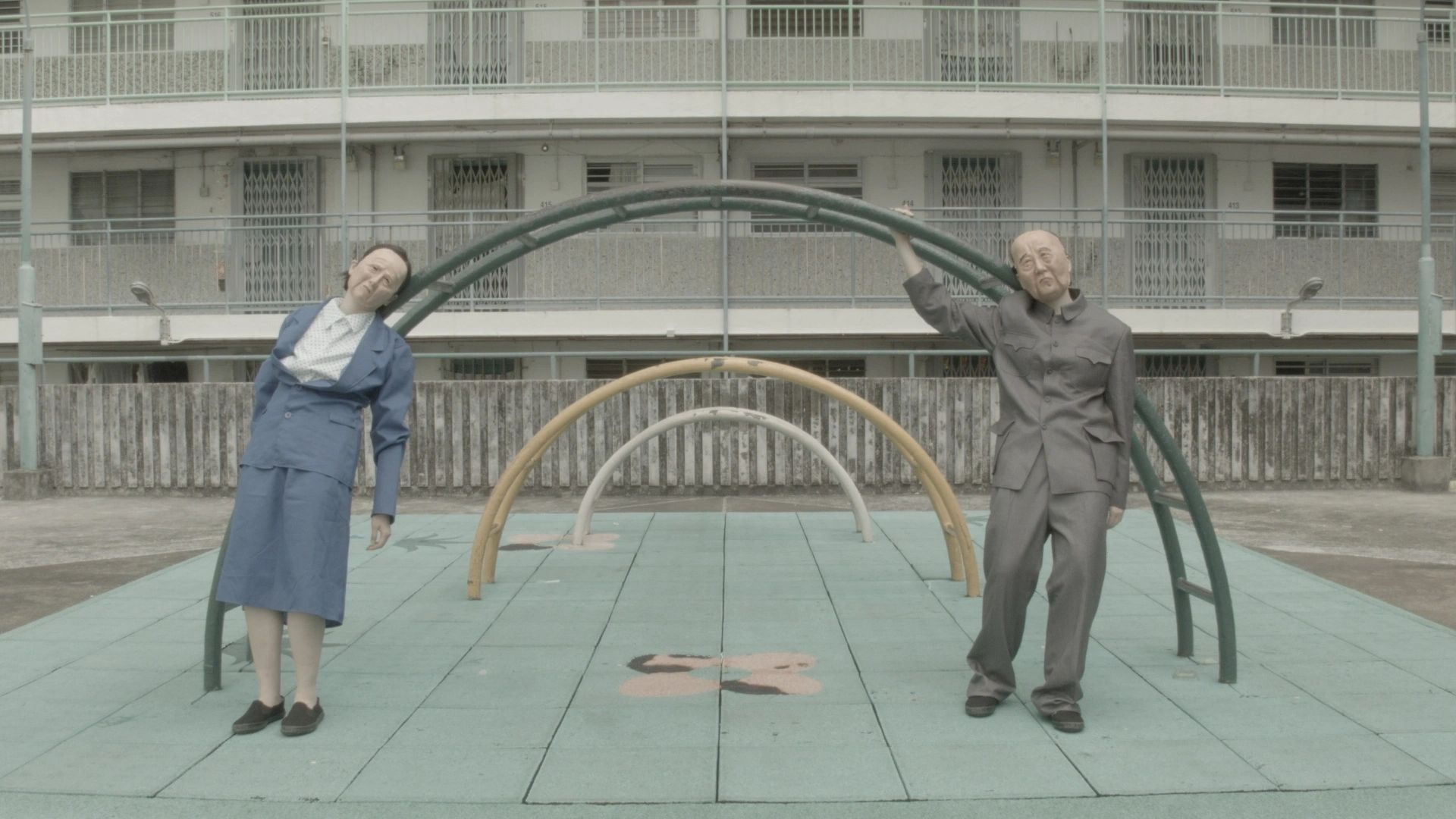
Bo Choy, War of Perception (video still), 2020. Image courtesy of the artist.
For her forthcoming project, Choy returns to Hong Kong — no longer through the lens of major historical events, but from a more personal register. She recalled that someone once described War of Perception sounding like “someone from outside Hong Kong looking in from a distance.” This prompted her to consider how, after leaving the city at seventeen, she had continued to understand it through childhood memory and the residue of a colonial education. This reflection resonated with the explorations of language, colonialism, identity, and migration in Mary Jean Chan's poems Sestina 【6】 and Written in Historically White Space (I) 【7】, leading her to situate the new moving-image project more explicitly within the trajectories of a postcolonial Hong Kong upbringing and a diasporic life.
The new work, she explained, will take the form of a fictional narrative centered on two childhood friends. Through their memories and conversations about public examinations, love, ambition, leaving home, and migrating to the United Kingdom, the film sets out to construct a linguistic and visual landscape of Hong Kong in the early 2000s. It engages not only questions of postcolonial identity but also broader themes of longing for home, fate, love, historical class structures, and diasporic memory. Choy also invoked Orhan Pamuk's The Museum of Innocence, 【8】noting how it builds the historical atmosphere and emotional density of Istanbul through the detail of objects and memory. She expressed her hope that the new film might achieve a comparably layered reconstruction of Hong Kong.
Choy closed by citing lines from Chan Chi Tak's I Do Not Know in Which Direction Hong Kong Blows:
"I do not know in which direction Hong Kong blows. / I do not know in which direction Hong Kong drifts. / I am in the sky; Hong Kong is on the ground, yet already it moves farther and farther away from me." 【9】
She connected the lines to the recurring experience of looking down at Hong Kong from an airplane each time she leaves, as the city recedes from view, offering them as an emotional articulation of her complicated relationship with Hong Kong.
Cici Wu: Dust, Leaving, and Returning
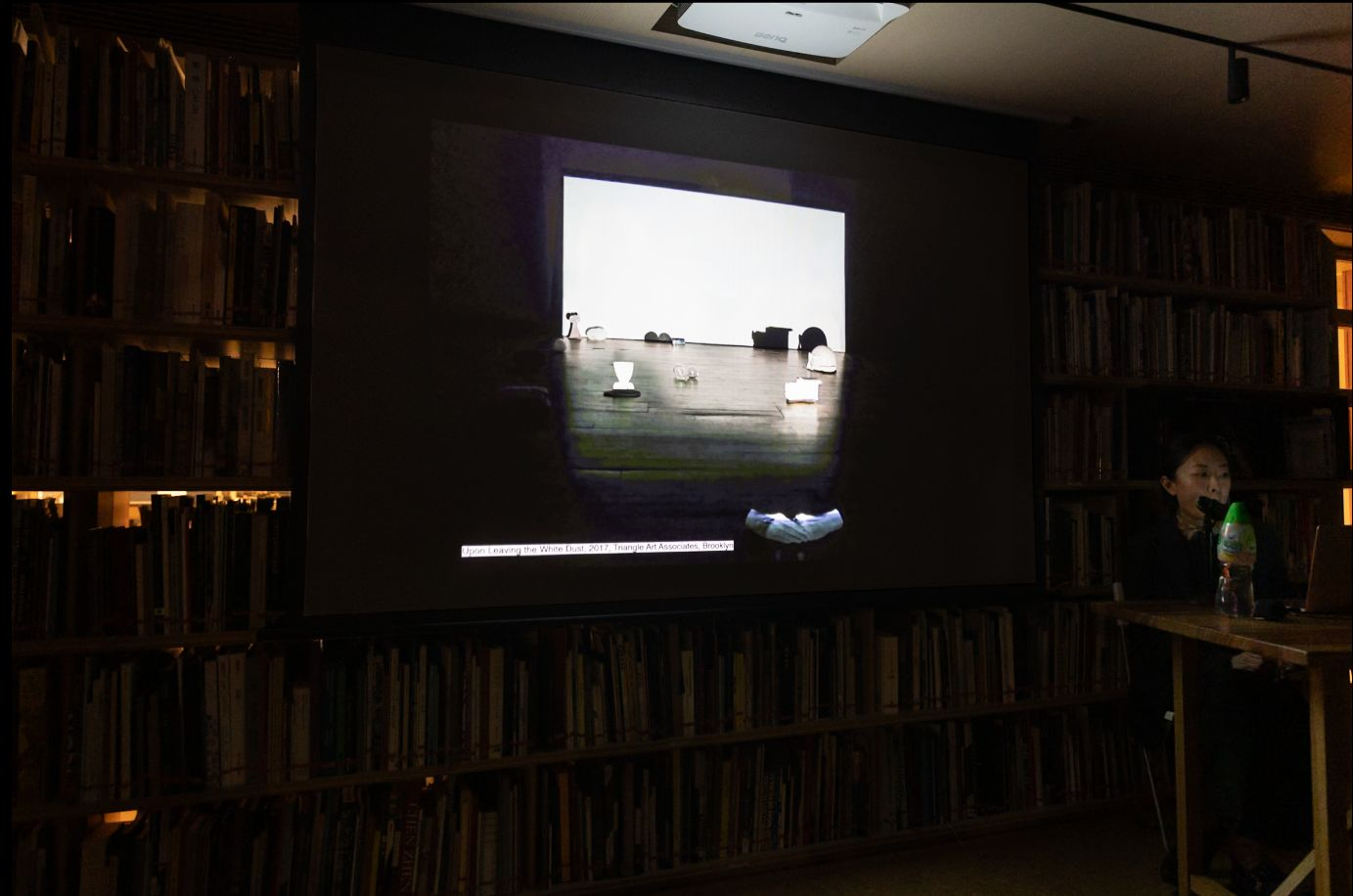
“Bloody Worm: Nomadic Bodies, Conscious Experience, and Embodiment Practice” Launch Event, March 31, 2026, Asia Art Archive (AAA) Library. Image courtesy of Zoie Yung.
Cici Wu began with a question: why is a research-based art project without being conditioned by the final output important, and why does research-based practice particularly need support in Hong Kong and mainland China? She shared that the reason she participated in the Bloody Worm project was because it allowed research to unfold without a predefined production outcome; for her, this openness is both a form of respect for an artist and also a necessary condition for work and life.
In tracing her own practice, Wu turned first to Upon Leaving the White Dust (Go Go She and Not Come Back Said Go and Don’t Come Back) ( (2018/2025) 【10】 as a point of entry, identifying "dust," "leaving," and "returning" as keywords recurring across her work over the years. Drawing on a passage from a collaborative letter exchange project, Wu noted that dust does not only drift in from far away, but is constantly being created, scattered, and gathered around us, and thus becomes a metaphor for memory, violence, love, home and history crossing borders【11】 This line of thinking connects directly to her long-term research, begun in 2016, into the archive of Theresa Hak Kyung Cha: film fragments, storyboard scripts, notes, statements and plans relating to Cha's unfinished film White Dust from Mongolia. 【12】
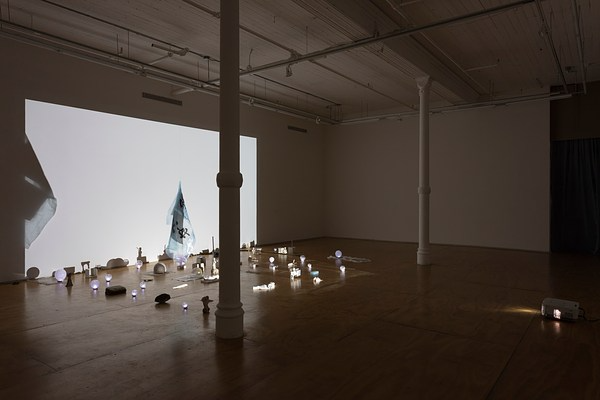
Cici Wu, Upon Leaving the White Dust, 2017/2018. Image courtesy of the artist and 47 Canal, New York.
Wu recalled encountering Cha's work while working at Asia Art Archive in New York. What drew her in, she said, was not only the traces of unfinished works in the archives, but the fact that these materials revealed a female perspective within structural film language and a deep reflection on the history and memory of East Asian colonization and post-coloniality. While studying the materials, she created a new set of cards corresponding to each individual shot from the Cha’s storyboards, materializing them across different media. Using light as a medium, she recorded and transformed the thirty-minute film footage left in the archives, abstracting the film into light.
From here, Wu further discussed Unfinished Return of Yu Man-hon (2019), presented at Empty Gallery in Hong Kong, which she described as the first movement in her practice from “leaving” to "returning". The work centers on an unresolved case: the disappearance of the Hong Kong boy Yu Man-hon at the Lo Wu (Shenzhen-Hong Kong) border in 2000. Through the connection between the two works, she traced both her research method and the process through which her conceptual framework has taken shape. She also cited her article written for the 2024 Asian Art Biennial, 【13】 in which she reflects on migratory aesthetics and time, and the beginning and ends of “Asia” as a conceptual construct. Through a conscious analysis, practice, and imagining of the layered meanings of "leaving" and "returning," Wu approaches migration as a position from which “new alignments and new solidarities” might begin at the point where “Asia ends.”
Within Bloody Worm, Wu hopes to continue organizing and practicing her research methodology while taking the recently completed Upon Leaving the White Dust (Go Go She and Not Come Back Said Go and Don’t Come Back) (2018/2025) as a point of departure, observing and learning from it as she develops the framework for a new project, which will begin in Japan this autumn.
Chan Ting: Green and the Perception
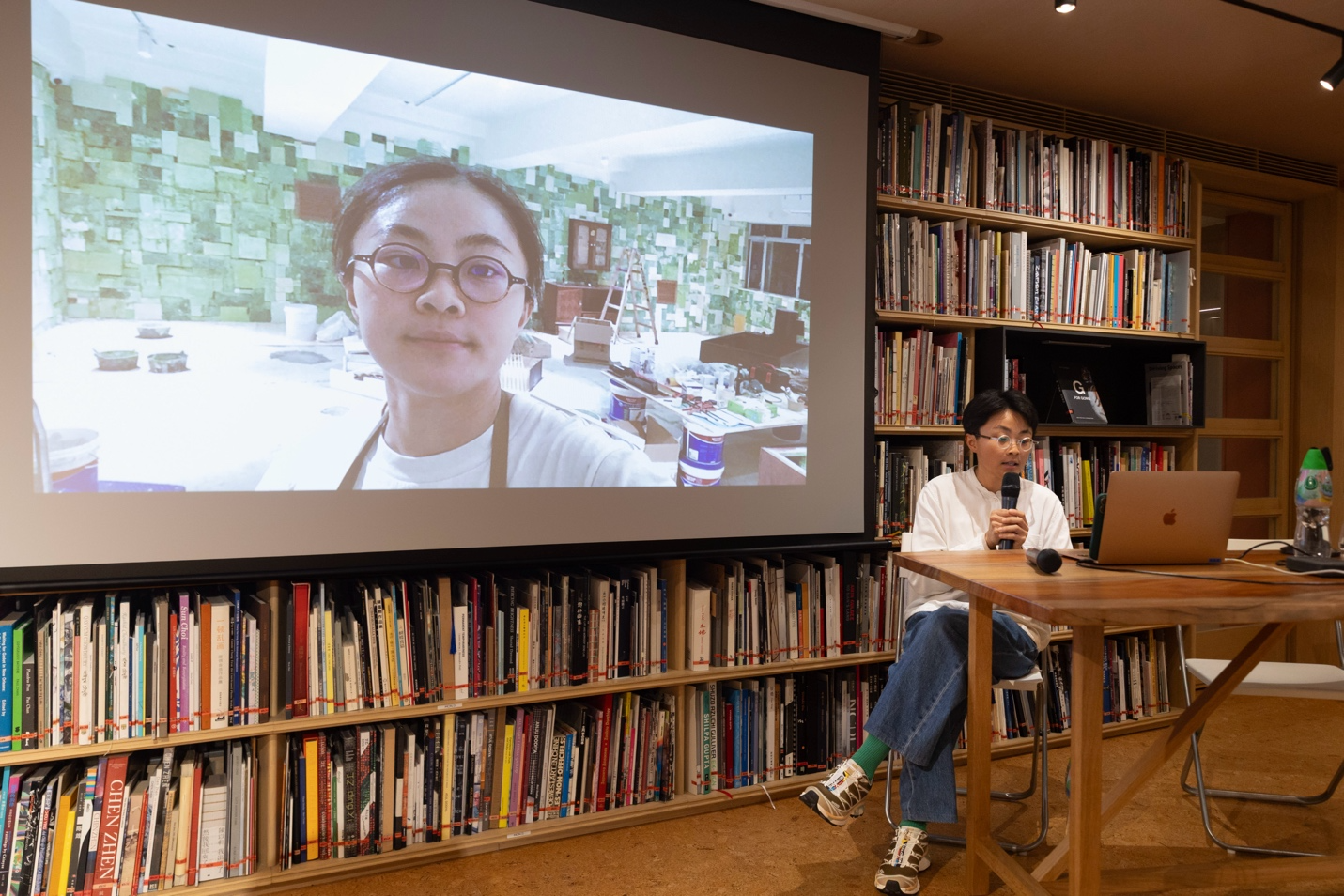
“Bloody Worm: Nomadic Bodies, Conscious Experience, and Embodiment Practice” Launch Event, March 31, 2026, Asia Art Archive (AAA) Library. Image courtesy of Zoie Yung.
Unlike the previous two artists whose presentations moved through existing films and archives, Chan Ting centered her presentation on materials, the color green, environment, and embodied experience. She began by reflecting on her practice as a Hong Kong local mixed-media sculptor working with abandoned objects, taking her recent solo presentation with Property Holdings Development Group in the Discoveries sector of Art Basel Hong Kong as a point of reference. Through her Abandoned Abundance series, she introduced an ongoing inquiry into discarded materials, green surfaces, and processes of transformation and regeneration. 【14】 Here she sketched several recurring threads in her recent work: abandoned or collected second-hand objects, traces of military green paints, moss, and the shifting relationship between Hong Kong's urban and rural environments.
Her residency at Para Site two years ago, as she explained, prompted a more concentrated study of green. She began with the moss she noticed at a funeral flower shop next to the Para Site building, treating it as a visual and material clue for thinking through the relationship between white-cube spaces and abandoned materials.
Between late 2023 and early 2024, Chan undertook a three-month residency in Para Site's 10/F annex, later developing the exhibition Moss Wonders. During the residency she gathered discarded objects, images, and sounds from the surrounding Quarry Bay area, taking the life cycle of moss as a guiding inspiration for her spatial and material investigations. 【15】 Working directly with on-site materials such as wooden boards and bubble wrap, she treated the expansion of moss, and its attempt to overtake the white cube, as a spatial and material metaphor. Within her broader research, moss is only one sub-topic under the large field of her study of color green. For Chan, the significance of green lies not only in its ubiquity across Hong Kong's streets, harbors, old shops, buildings, and commuting routes, but in the contradictory symbolic meanings such as military, killing, healing, legacy, and restoration. She also discussed her ongoing collaborative performance series To Kill or To Heal?, made with the Hong Kong performance artist Florence Lam. The work extends her inquiry into green and its layered political and affective meanings. First presented during the 2024 exhibition dreamskin at Property Holdings Development Group, it continued in 2025 at Wonderfruit, Thailand, as To Kill or To Heal? A Ritual of Inner Alchemy. Across this development, military green was transformed from a symbol of war into a ritual medium for healing and collective perception. 【16】
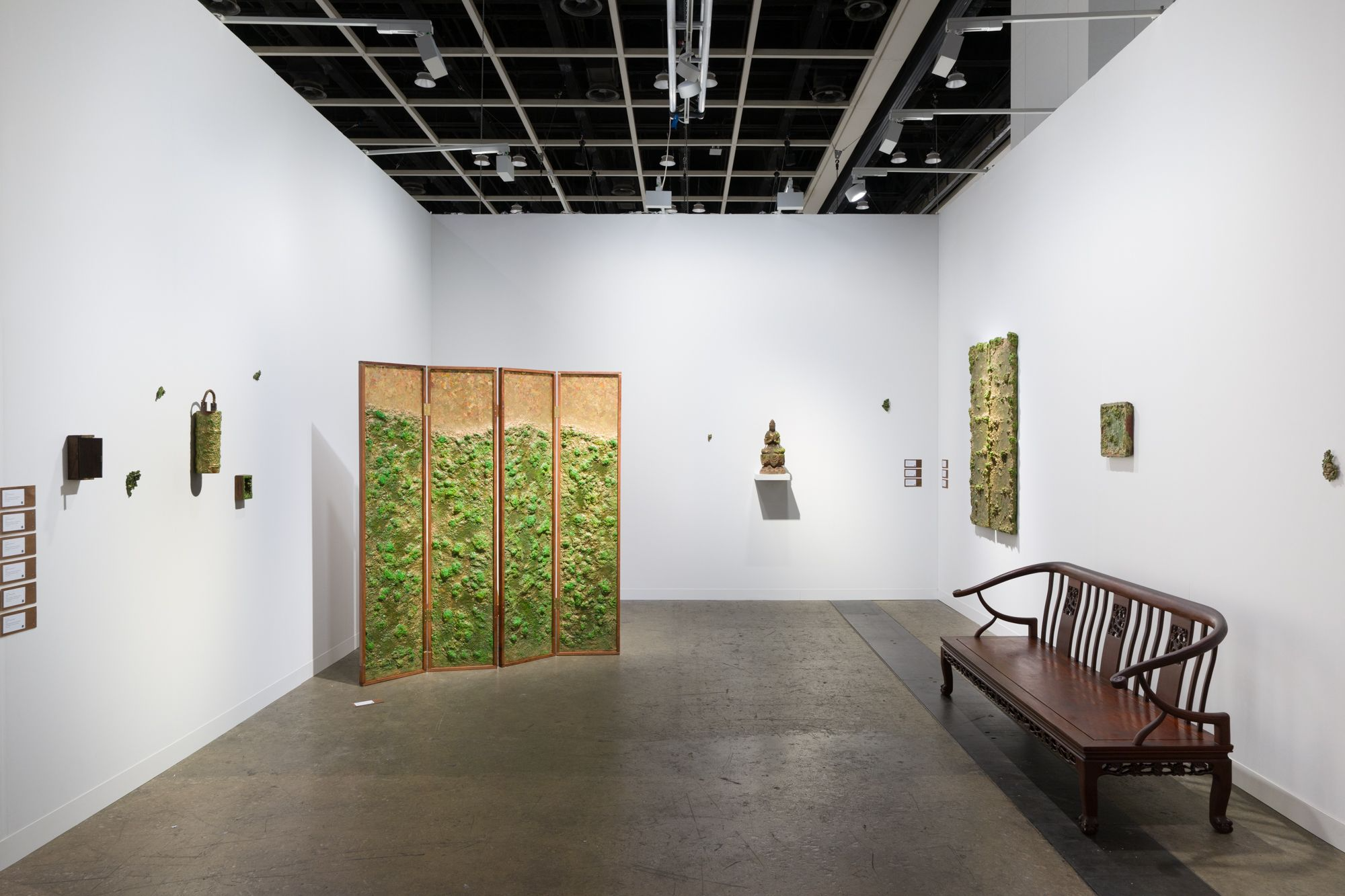
Chan Ting, Abandoned Abundance, Art Basel Hong Kong Discoveries, 2026, mixed media. Image courtesy of Property Holdings Development Group.
In the latter part of her talk, Chan shifted from existing works toward her present working environment and the methods she will carry into Bloody Worm. After leaving her first studio in Foo Tak Building, she noted, her studios have been located largely in Hong Kong's more rural areas; she now lives and works on Lantau Island. For her, the surrounding environment itself functions as a laboratory. Rather than attempting to completely control or monitor the moss and natural phenomena she admires, she hopes to learn another rhythm of growth and the logic of coexistence from them. She ended the first story with a sentence that she has deeply remembered for many years: "If plants are black, they can absorb more sunlight, but fortunately, that is not the case," and hinted that this perception of non-efficiency and non-maximization principles also constitutes a certain ethical foundation in her artistic practice.
She then used the photos and short videos in her mobile phone as clues to describe how she relearned to walk, how she observed, and how she perceived a different time and order between the village and the city. She described a drainage channel near where she lives and works, dry during the day and wet at night, where “water rises and retreats like tides.” This reversible state, a path becoming a stream and then turning back again, speaks to a different tempo and logic from that of the city. She also recalled having to stop her bicycle in the village to let a herd of water buffalo pass, “They are the kings there,” she said, noting how things can be turned around in Hong Kong’s rural areas, and how the daily interruptions and reversals of rural life continually reshape one's perceptual habits. These experiences were tentatively gathered in a filmed image notes she made last year, from which she screened a four-minute excerpt. Shot around her former studio in Lam Tsuen, Tai Po, in the New Territories, the footage interweaves scenes of countryside and everyday life with monologues spoken by camouflaged soldiers from war zones, and Cantonese opera courtesans singing Peony Pavilion in the village. This video material has become the true point of departure for her participation in Bloody Worm.
Within this still-forming new project, Chan does not assume the work will settle into any fixed form. Her filmed image notes, she explained, may eventually become a moving-image work, a video installation, or something not yet named. She ended by recalling an old news story she came across on Instagram: A drunk person who went missing in Turkey had helped search for himself in the forest for several hours. The reason why this slightly absurd news was important to her was not because of its status as a social event itself, but the way its absurdity reminded her of the work itself: the character, or perhaps the artist herself, might be searching for something throughout the development of the film or video work. In this sense, Chan's sharing offered a particularly concrete expression for the experimental, undefined and process-oriented nature emphasized by Bloody Worm.
Bibliography and References:
- Claude Lèvi-Strauss, ‘The Sorcerer and His Magic’, in Structural Anthropology (New York: Basic Books, 1963), 175; Franz Boas, The Religion of the Kwakiutl Indians (New York: Columbia University Press, 1930)
- Bo Choy, War of Perception, 2020, https://vimeo.com/731441511?fl=pl&fe=vl
- Bo Choy, These yearnings of the exiled souls, to which Time shall we send them? (poem); Yearning of the Exiled Souls, 2022; https://dissolving.earth/commissions/these-yearnings-of-the-exiled-souls-to-which-time-shall-we-send-them/
- Dissolving Earths is an online exhibition and research framework curated by Sophie J. Williamson. https://undeadmatter.com/
- Chris Marker, dir. Sans Soleil. Argos Films, 1983.
- Mary Jean Chan, ‘Sestina’. In Bright Fear. (London: Faber & Faber, 2023)
- Mary Jean Chan, ‘Written in Historically White Space (I)’. In Flèche. (London: Faber & Faber, 2020)
- Orhan Pamuk,The Museum of Innocence. Translated by Maureen Freely. (London: Faber & Faber, 2010)
- Chi Tak Chan, ‘我不知道香港往哪一個方向吹 (I Do Not Know Which Way Hong Kong Will Go)’. In 離亂經 (Luan Li Jing), translated by Bo Choy. 2046 Press, 2025.
- Cici Wu, Upon Leaving the White Dust (Go Go She and Not Come Back Said Go and Don’t Come Back). 2025 2018. Ink, rice paper, bamboo wire, wheat glue, handmade glass, LED lights, electronics, bells, 16mm film transferred to HD video (black and white, 19 minutes 40 seconds), and 30-minute video using light data collected from the screening of unfinished film footage White Dust from Mongolia by Theresa Hak Kyung Cha (1980)., Dimensions variable.
- Isabelle Utzinger-Son et al., ‘Between Delivery: Letter Threads After the Theresa Hak Kyung Cha Archive (Part II)’, Center for the Humanities, 18 December 2025, https://centerforthehumanities.org/between-delivery-letter-threads-after-the-theresa-hak-kyung-cha-archive-part-ii/.
- Theresa Hak Kyung Cha, dir. White Dust from Mongolia. Berkeley Art Museum and Pacific Film Archive, 1980.
- Cici Wu, ‘Migratory Positions: Dissolution into Worldly Diasporic Time’. 2024 Asian Art Biennial, 2024.
- Chan Ting, Abandoned Abundance. 2026. Mixed Media.
- Para Site hosted Chan Ting for a three-month residency (November 2023–February 2024) in its tenth-floor annex. https://www.para-site.art/2023/12/07/para-site-hosts-chan-ting-for-three-month-residency/
- Chan Ting, To Kill or To Heal?, in collaboration with Florence Lam and HengSyun, Hong Kong: Property Holdings Development Group, August 16–17, 2024; in collaboration with Florence Lam, Pattaya, Thailand: Wonderfruit, December 13, 2025.
Appendix I: Literary Excerpt
Chi Tak Chan (陳智德)
「我不知道香港往哪一個方向吹」 in 《離亂經 》(Luan Li Jing)
Original Chinese (poem excerpt):
我不知道香港
是往那一個方向飄──
我是在空中,
香港即使在地面
卻已去得更遠更遠