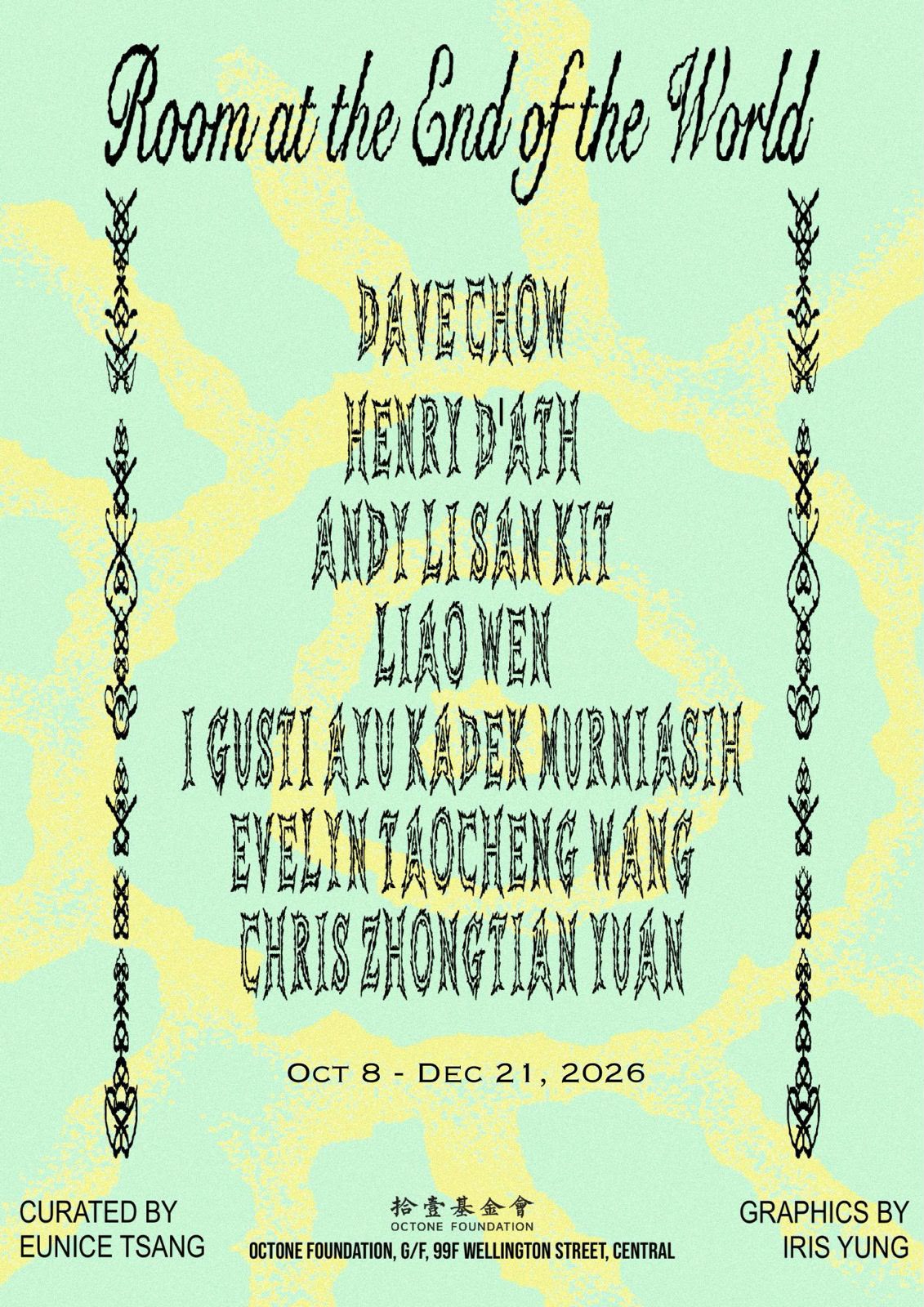
A Room at the End of the World 天涯一室
Octone Foundation, 99F Wellington Street, Central, Hong Kong
Artists: Dave Chow (HK), Andy Li San Kit (HK), Henry D’Ath (NZ), Liao Wen(CN), Chris Zhongtian Yuan (CN/UK), I Gusti Ayu Kadek Murniasih (IND), Evelyn Taocheng Wang (CN/NL)
Curator: Eunice Tsang (HK)
Throughout history, the cave has served as both a quiet sanctuary and a power plant for the mind. Carved into mountains or discovered in subterranean landscapes, these chambers have long acted as spaces of psychological rebellion: rooms where the mind detaches from the world's momentum and constraints, and expands into a freedom of its own making.
For the inaugural exhibition of the Octone Foundation, 99F Wellington Street becomes our modern-day stone chamber. Sitting within Hong Kong’s hyper-dense and uber-consumerist core, this pre-war shophouse has lived many lives. Within its concrete bones vibrate strange frequencies and subcultural rhythms - first as a Malaysian merchant’s trading post, a clandestine underground jazz bar, a neighborhood hair salon and now, a sanctuary for contemporary art and experimentation. Stepping into it carries both the thrilling responsibility of stewarding a new art space and the trepidation of entering an unexplored cave; a delicate suspension of time where historical echoes encounter a nascent state of possibility.
The seven artists convene here to map out the volatile mental topography of creative exploration, traversing stages of uncertainty, curiosity, danger, discovery, and joy. Each deploys distinct methodologies to carve out personal niches, building emotional fortresses against the world's relentless acceleration. The cave is reimagined as a psychological sanctuary which artists laboriously hand-carve with intention and care, just as those who passed before us did, each with their own distinct voice. Refuge, chaos, delusion and joy collide, revealing how the act of making becomes an act of radical self-liberation and survival.
At the end of the world, how does the act of making create refuge? What desires and monsters emerge when we give ourselves permission to step into the shadow?
This is the first act of a three-part exhibition series. Supported by Octone Foundation, the series will be developed by Eunice Tsang through ongoing artistic research and cave exploration, culminating in one exhibition per year from 2026 to 2028.
Institutional Vision: Supporting Curatorial Research and Cultural Connections
The exhibition is made possible through the initiative of the Octone Foundation and is the first part of a three-year curatorial research project initiated by curator Eunice Tsang, who will explore how ancient Chinese rock carvings, grottoes, vernacular space-making, and grassroots sanctuaries inspire contemporary modes of artist self-organisation in China and Hong Kong. Drawing parallels between historical sites of refuge and modern collaborative practices across performance, publishing, and spatial design, the initiative uses its inaugural exhibition as a foundational sketch to examine art as an enduring shelter for collectivity, memory, delusion and belief.
At the core of this initiative is the Octone Foundation’s commitment to research-led curatorial practices and experimental projects. By establishing a framework for sustained inquiry, the Foundation aims to carve out a critical space for artists, writers, and curatorial practices that are emerging, underrepresented in mainstream discourse, or driven by breakthrough visions. Octone Foundation approaches curatorial projects and research as a dynamic, generative process, shaping them into a testing ground for alternative methodologies rather than a static presentation of outcomes. In doing so, the Foundation seeks to act as a grounded support structure and an active participant in shaping Hong Kong’s art ecology, expanding the possibilities for forward-looking and experimental cultural production.
Through this partnership, the Octone Foundation positions itself as an active incubator within the Hong Kong and broader Asian art ecosystems, nurturing independent curatorial voices outside established systems.
Octone Foundation, established in Hong Kong in 2022, is dedicated to promoting social mobility and the long-term development of a harmonious society through the power of art and culture. Guided by a commitment to public service and social responsibility, the Foundation supports education and charitable initiatives, with a particular focus on low-income communities, arts access for children and adolescents, and practical support for young artists and emerging creative and cultural projects. With the support of its Chairman, He Fan, the Foundation has sponsored exhibitions and programs including: Stay Connected: Art and China since 2008, Tai Kwun Contemporary, Hong Kong, 2024; a scholars’ guided tour for The Great Disguise, Rockbund Art Museum, Shanghai, 2024; Shuang Li’s first European institutional solo exhibition Alliance, Kunsthalle Basel, Basel, 2026; and Lee Bul: From 1998 to Now, M+, Hong Kong, 2026. By championing experimental projects and supporting independent curatorial practices, the Foundation hopes to cultivate critical conditions for independent artistic expression, ensuring that diverse cultural initiatives ultimately benefit the broader public.
Eunice Tsang is a Hong Kong-based cultural worker whose practice is rooted in community-building and the power of collective experience. As the founder and director of Current Plans, a nonprofit art space established in 2020, she has been highlighting playful and cross-disciplinary dialogues, from performance parties to communal cooking, to foster a social ecosystem where emerging creatives and the public interact beyond the passive gaze of the gallery. Tsang’s institutional experience includes her role as Associate Curator at M+, where she co-curated the Asian Avant-Garde Film Festival and the museum’s Live Art program. Her international footprint is marked by curatorial research at Fondazione Prada (2025) and the Fondazione Sandretto Re Rebaudengo Young Curators Residency (2022), Colours of Humanity Arts Prize at the Goethe-Institut (2024-ongoing), and the Trieste Biennale (2023).
Dave Chow (b.1993, Hong Kong) is a mixed-media artist working in sculpture and installation. His practice centers on the appropriation and reassembly of mass-produced industrial and everyday materials. He examines systemic powerlessness, desire, fragility, impermanence, and absurdity by physically and emotionally disrupting the viewer’s navigation of space, channeling collective narratives of adaptation, labor, and defiant humor.
Andy Li San-kit (b. 1994, Hong Kong) is an experimental filmmaker and photo-based artist who weaves the machine into the image, treating the medium as the message. His practice emphasises the relationship between the photographed subject and the documentation process, with works spanning 16 mm film, photography, video, installation, and photo objects. A member of the Floating Projects Collective and cofounder of Negative Space (2019–2022), Li continues to explore the intersection of film as moving image and as object.
Henry D’Ath (b. 1991, New Zealand, working in Hong Kong) operates at the intersection of sculpture, structural design, and functional furniture. Raised on a farm, where limitations meant making with what was at hand, he works in wood, steel and plastic using low-tech methods familiar from farm life. Set against his present-day experiences in the city, this approach shapes work that explores contradictions of perception and place. After several years in architecture, he began his sculptural practice in 2020 while living in Shanghai, and now works from a studio and workshop in Hong Kong.
Liao Wen (b. Chengdu, China) is an artist based in Hong Kong, whose practice encompasses sculpture, video, and performance. She frequently integrates puppet elements with sculpture to create bodies that are charged with tension or evoke empathy, often presented in states of fragmentation and deformation. Her practice is deeply autobiographical yet also informed by extensive research into rituals, myths, social customs, and technology. Through this lens, she focuses on oppressed and regulated bodies, exploring themes of control and vulnerability, as well as harm and protection.
I Gusti Ayu Kadek Murniasih (1966–2006, Bali, Indonesia) was an Indonesian artist whose bold practice radically explored female desire, bodily autonomy, and psychological vulnerability through painting, soft sculpture, and metalwork. Subverting traditional Balinese conventions learned in Ubud, her surreal, cartoon-like figures and sexually explicit forms challenged societal expectations of female sexuality and reproduction, transforming personal trauma into empowering, dream-like narratives.
Evelyn Taocheng Wang (b. 1981, Chengdu) is a Rotterdam-based artist whose multidisciplinary practice spans painting, installation, fashion design, and performance. Blending conceptual rigor with humor and research, Wang integrates traditional Chinese art, queer identity, and colonial history to question fixed cultural norms.
Chris Zhongtian Yuan (b. 1988, Wuhan) is a London-based artist working across sound, moving image, performance, sculpture, and installation. Trained as an architect, Yuan draws on punk, free jazz, and noise music to produce site- responsive, improvisationally driven works that transform institutional spaces into sites of theatricality and resonance. Yuan’s work dissolves the boundaries between exhibition space and theatrical set, between critique and imagination, staging encounters that unsettle fixed narratives of place and belonging.