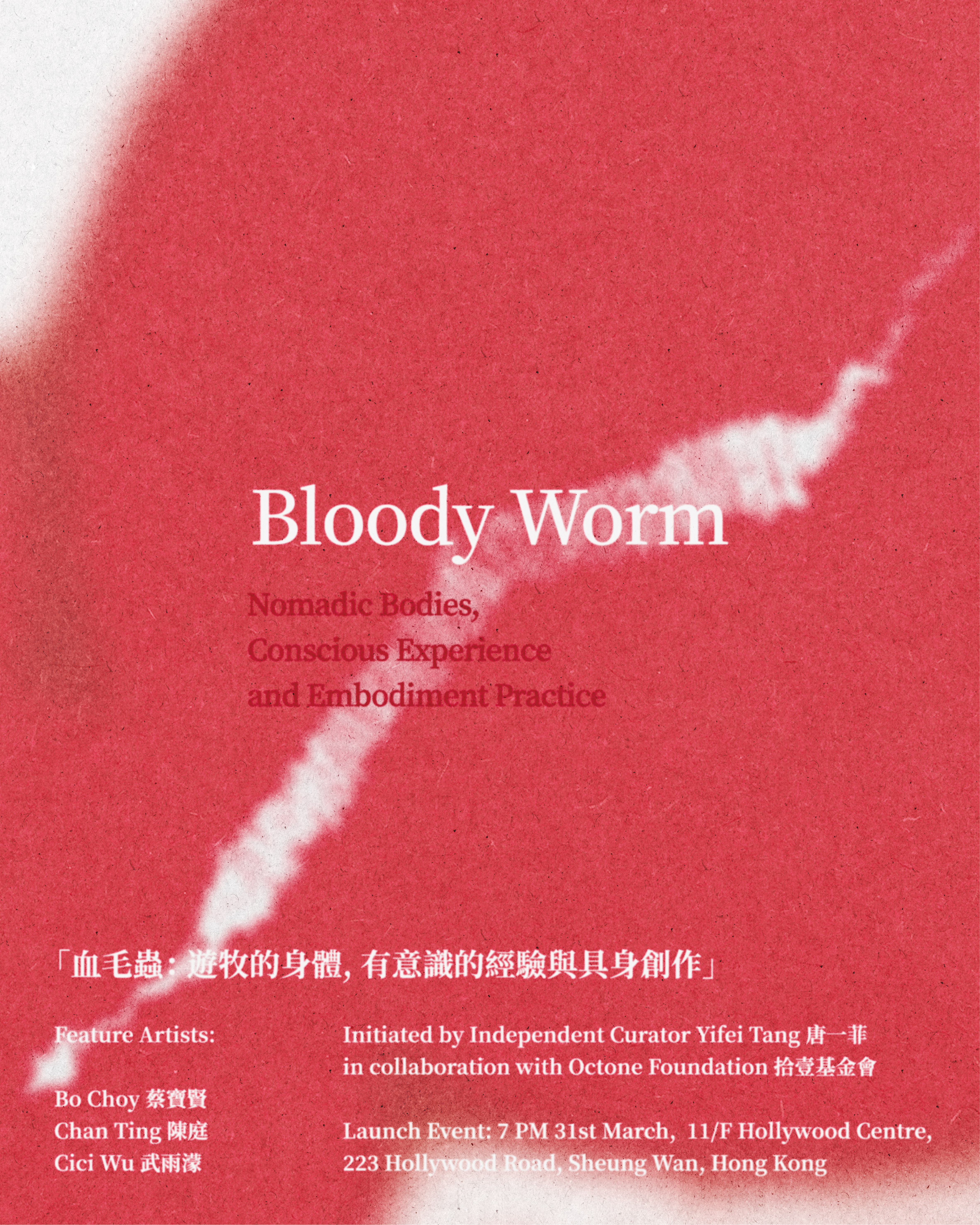
Poster Design: Botu Yin
Bloody Worm: Nomadic Bodies, Conscious Experience, and Embodiment Practice
Launches as a Year-Long Curatorial Project
Jointly initiated by Octone Foundation and independent curator Yifei Tang, with a launch event at Asia Art Archive
HONG KONG — Octone Foundation announces the launch of Bloody Worm: Nomadic Bodies, Conscious Experience, and Embodiment Practice, a new year-long curatorial project jointly initiated by the Foundation and independent curator Yifei Tang. Bringing together artists Bo Choy, Cici Wu, and Chan Ting, the project centers on specific work plans developed by each artist within the framework of the initiative. Over the coming year, Bloody Worm will unfold through close observation, collaborative research, and flexible funding mechanisms, sustaining both artists’ developing practices and curatorial dialogue over time. The launch event will take place on 31 March 2026 at the Asia Art Archive Library.
Rather than adhering to a short-term commissioning model centered on a single exhibition outcome, Bloody Worm unfolds as a sustained framework for curatorial support. It does not ask the participating artists to produce a finished form of work within a fixed timeframe; instead, it understands research, exchange, experimentation, and even incompleteness as integral to the work itself.
For the Foundation, this is not only a project of support, but also an attempt to create relatively independent and sustained conditions for curatorial research and artistic experimentation beyond the frameworks of galleries, collectors, and existing modes of production.
The title “Bloody Worm” traces back to an account of the Kwakiutl shaman Quesalid on the Northwest Coast of North America, preserved through Indigenous testimony recorded by Franz Boas and later circulated within anthropological discourse. In this healing technique, the shaman produces a bloodstained tuft from the mouth, presenting it as the pathological foreign body extracted from the patient. What is otherwise invisible and inarticulable is thus transformed into an external and tangible form—something that can be seen, sensed, and believed. The project borrows precisely this association between inner affliction and externalized form, not in order to aestheticize mysticism, but to think through a relational structure in which healing, narration, and perception become possible. In this sense, the artists enter a conscious process of dissection, confrontation, and reconfiguration across self-history, family history, cultural inheritance, and historical residue; they act simultaneously as both shaman and patient, as carriers of sensibility and producers of narrative.
The three participating artists work across writing, performance, video, installation, sculpture, and painting, yet each begins from concrete and intimate experience before extending outward into broader historical, cultural, and social registers. Bo Choy’s practice attends to postcolonial identity, individual and familial memory, and the narrative charge of Far Eastern folk traditions and rituals. Cici Wu departs from cinematic language, extending its imaginative and structural premises across objects, installations, and moving images, while taking local microhistories and archives as points of departure for reflecting on historical and cultural belonging. Chan Ting works through secondhand objects, industrial pigment, and material remains from everyday life, continuing to engage questions of postwar Hong Kong, material residue, and collective memory. Their practices are distinct in form, yet share a sensibility shaped by embodiment, migration, and the sedimentation of history.
Within the project, the term “nomadic” refers not only to geographic movement, but also to the artists’ lived negotiations across historical layers, cultural positions, and interdisciplinary experience. What emerges is a form of intersubjective nomadism. In this context, Bloody Worm approaches artistic practice not as isolated self-expression, but as an embodied practice entangled with intimacy, kinship, cultural memory, and collective affect. The artists’ choices about what to narrate, withhold, or transform become ways of reinterpreting history and contemporary perception, and of articulating politically conscious practices that are deeply embodied.
As a year-long project, Bloody Worm establishes an academic framework comprising internal meetings, fieldwork, research support, and process archiving, alongside initial funding, research subsidies, and targeted flexible support responsive to specific needs in research, production, travel, and local practices. Throughout the year, each artist will have the opportunity to host at least one artist-led event tailored to the progress and context of the work, with formats that may include performances, tea gatherings, walks, and community interventions, taking place in London, Japan, and Shanghai. In March 2027, the project will culminate in a final presentation at the Foundation’s space in Hong Kong, bringing together the artists’ works and related materials. Notably, the project does not require completed works within a year. Fragments, derivatives, work diaries, meeting reports, and the creative process itself are all recognized as integral to the project’s evolving form. It also allows for the possibility that artistic exploration may fail, because the willingness to remain with uncertainty is itself central to the ethics and methods of artistic practice.
The launch event at Asia Art Archive marks both the project’s first public moment and the beginning of a broader opening of its method to public encounter. On 31 March, from 7:00 to 9:00 PM, the curator and participating artists will gather at the Asia Art Archive Library to share the project’s framework and current thinking, followed by a live Q&A. As a curatorial initiative grounded in accompaniment, research, and long-term dialogue, Bloody Worm does not treat public announcement as an endpoint. Rather, it proposes another beginning: one in which artistic practice is allowed to ferment through time, methods are revised through experience, and cultural connections between the Foundation, curator, artists, and public are built gradually and with care.
For Octone Foundation, Bloody Worm extends a broader direction of cultural support that has become increasingly central to its work in recent years.
Launch Event Information
Bloody Worm: Nomadic Bodies, Conscious Experience, and Embodiment Practice
Date: 31 March 2026
Time: 7:00–9:00 PM
Venue: Asia Art Archive Library
Curator: Yifei Tang
Artists: Bo Choy, Cici Wu, CHAN Ting
Supported by: Octone Foundation
RSVP: bloodywormproject@gmail.com
About Octone Foundation
Octone Foundation was established in Hong Kong in 2022, and is dedicated to promoting social mobility and the long-term development of a harmonious society through the power of art and culture. Guided by a commitment to public service and social responsibility, the Foundation supports education and charitable initiatives, with a particular focus on low-income communities, arts access for children and adolescents, and practical support for young artists and emerging creative and cultural projects. With the support of its Chairman, He Fan, the Foundation has sponsored exhibitions and programs at institutions including Tai Kwun Contemporary in Hong Kong (for Stay Connected: Art and China since 2008), a scholars’ guided tour for The Great Disguise at the Rockbund Art Museum in Shanghai, and exhibitions and programs at M+ in Hong Kong, helping create conditions for artistic expression and ensuring that cultural initiatives benefit the broader public. Currently, “Godly, Ghostly”, an exhibition curated by Chris Wan and fully supported by Octone Foundation is open to the public at 33/F, M Place, Wong Chuk Hang, Hong Kong.
About the Curator
Yifei Tang (b. 1997) is an independent curator and writer based in Shanghai, China. She graduated from the Curating Contemporary Art program at the Royal College of Art in London. Yifei has curated exhibitions and projects at various institutions, including the artist-run organization "xiaozu" in Beijing, the Wind Art Center in Beijing, the Hive Center for Contemporary Art in both Shanghai and Beijing, the Institute for Provocation in Beijing, and Furtherfield in London. Her writings have appeared in ArtReview and Heichi Magazine. Yifei has developed an in-depth practice that combines research, writing, and fieldwork, fostering close collaboration and dialogue with artists. Her work also created alternative frameworks among different organizations. In recent years, she has focused on performative projects that explore embodied metaphors and the multiple bodies, generating action and contamination for comparative narratives to reveal the ideological weight embedded within societal and cultural constructs.
About the Artists
Bo Choy (b. 1986) was born in Hong Kong and currently based in London. Bo Choy makes films and performances using writing, sound, costume and movement as devices. Fiction is an integral part of her work, weaving imaginary and extraordinary elements into a narrative that is otherwise rooted in the everyday. Her work often uses personal memory as a starting point to explore diverse themes such as postcoloniality, ancestral past and present, and our body’s relationship to the land. She has exhibited across Europe and Asia. Selected screenings and exhibitions include: Grand Popo Contemporary Art Festival (2026), Shedhalle, Zurich (2024), B3 Festival of Moving Image, Frankfurt (2023), Hive Centre of Contemporary Art, Beijing (2023), South London Gallery, London (2022), Kasseler DockFest, Kassel (2021). She is also a lecturer at Chelsea College of Art in London.
Cici Wu (b. 1989, Beijing) is a New York based artist and grew up in Hong Kong. Reducing filmmaking to its most humble and elemental components, she creates drawings, objects, videos, and installations which extend the imaginative and structural premises of cinematic language across a wide range of media. Often taking local microhistories or archives as a point of departure, she uses the cinematic frame as a means to negotiate and reflect on the ways in which transpersonal narratives of social, cultural and historical belonging structure our experiences of self. She has exhibited at major art events including the 36th Biennial de São Paulo (2025), Asian Art Biennale, Taiwan (2024), the 11th Seoul Mediacity Biennale, South Korea (2021), and Yokohama Triennial, Japan (2020). Her work has been the subject of solo exhibitions at the Rockbund Art Museum, Shanghai (2025), Scheusal, Berlin (2024), Empty Gallery, Hong Kong (2023, 2019), Hordaland Kunstsenter, Norway (2023), and 47 Canal, New York (2021, 2018), and has participated in group exhibitions at Berkeley Art Museum and Pacific Film Archive (2026), Palais de Tokyo, Paris (2025), National Taiwan Museum of Fine Arts (2024),and Para Site, Hong Kong (2020, 2018), among others. She has organized exhibitions and screenings at 99 Canal, New York (2025), Giorno Poetry Systems, New York (2024), and M+, Hong Kong (2023), among others. Her work will be included in Greater New York at MoMA PS1 (2026).
Chan Ting (b. 1993) is a multidisciplinary artist based in Hong Kong. Their work features secondhand objects sourced from marketplaces or domestic residences. After collecting these objects and their personal stories, she transforms them in her studio through a meditative practice of painting, sanding, polishing, and varnishing. In exploring the lost functions of these objects, often abandoned or displaced by previous owners, she examines hyper-capitalist attachments to fixed value and use, and the paradox of an ever-accumulating world that still feels empty. Through “painting” these objects with green industrial pigment, a material typically found in hardware stores in Hong Kong, Chan Ting highlights reinvention and reclamation. Chan Ting holds an MFA in Fine Arts from the Chinese University of Hong Kong. She has exhibited works in Tai Kwun Contemporary, Para Site, and HART Haus, among other venues, and participated in a residency at Foo Tak building from 2019 to 2022, during which she co-founded the nonprofit project Negative Space. She was one of the grantees of the NoExit Grant for Unpaid Artistic Labour organized by Para Site and was the resident artist at Para Site’s 10/F space in 2023.